
Table of Contents
The conversation around AI in marketing used to sound like science fiction. A few years ago, most marketers were cautiously experimenting—testing ChatGPT for social media captions, exploring AI for blog ideas, wondering if this technology would replace their jobs.
Today, the role of AI in digital marketing has fundamentally shifted. It’s no longer experimental. It’s woven into how campaigns actually get built.
But here’s what might surprise you: AI didn’t take over marketing. Instead, it made strategic marketers significantly more productive, faster at testing, and better equipped to understand what actually works. The most successful campaigns now combine AI’s ability to process data and generate ideas at scale with human judgment, creativity, and genuine understanding of audience psychology.
This shift changes everything about how you should think about using AI in your marketing work.
The Shift From Tool to Necessity
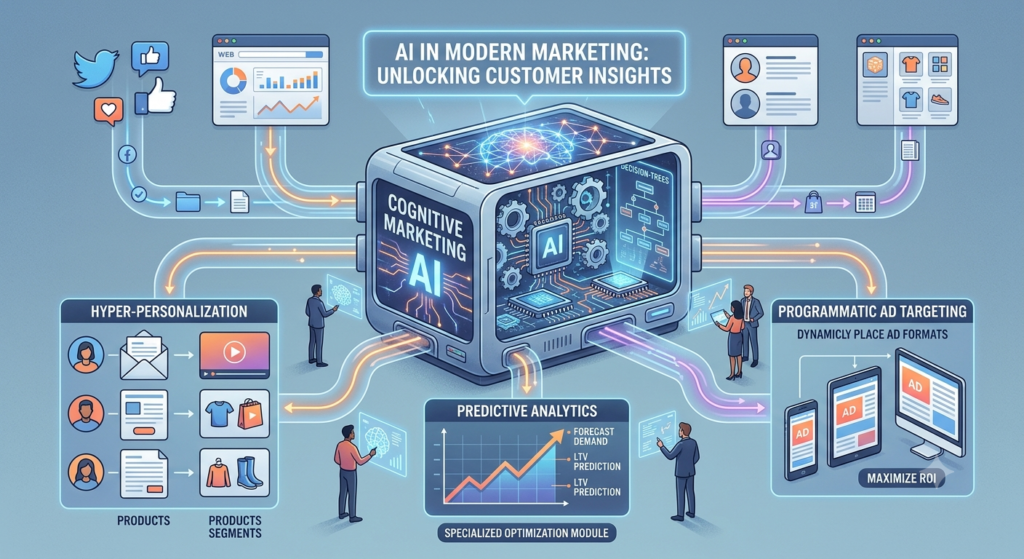
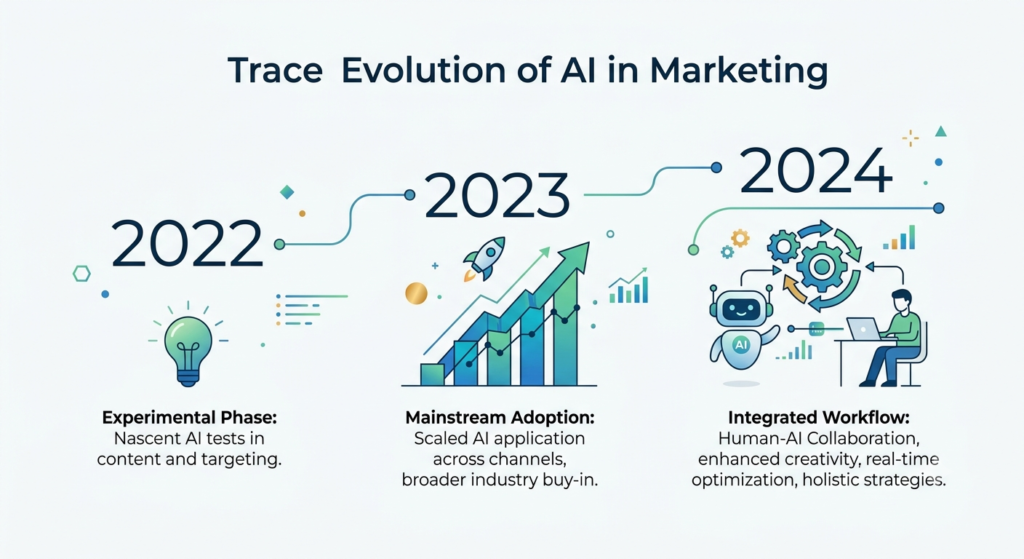
Just 18 months ago, using AI for marketing felt like an advantage. A competitive edge. Something you’d mention in a case study.
Now it’s simply how work gets done.
The change happened quietly. Marketers stopped asking, “Should we use AI?” and started asking, “How do we use AI responsibly and strategically?” Tasks that once consumed entire days—keyword research, content brainstorming, ad copy variations, email campaign outlining—are now handled in hours. That time savings doesn’t disappear; it redirects.
Instead of spending a full day researching and drafting a single blog post, a marketer can now research, draft, and review three blog posts in the same time. That doesn’t mean publishing three mediocre posts. It means testing more ideas, gathering more performance data, and refining strategy based on what actually resonates with your audience.
Iunnimadhav.com saw this play out directly on a campaign for a local business struggling with organic visibility. We managed their website content, social media, and Google Ads. The traditional approach would have been: research keywords manually, brainstorm a few content ideas, spend a day writing and optimizing one blog post, publish it, and wait to see if it ranked.
Instead, we used AI to accelerate research, identify search intent behind customer questions, and generate content outlines. But that first draft wasn’t the finish line—it was just the starting point. We then rewrote sections to match the brand’s voice, added local context, verified facts, and refined the messaging based on what we knew about the audience.
The result? We produced significantly more quality content in less time. Within three months, organic traffic increased 35%. Target keywords moved to page one of Google. Better yet, the website started receiving more qualified inquiries because the content answered exactly what potential customers were searching for.
That’s where the Role of ai in Digital marketing delivers real value—not by replacing the strategist, but by amplifying the strategist’s reach.
How AI Actually Works in Modern Marketing
The mistake most marketers make is treating AI like a finished product. They ask it to “write a blog,” make minor edits, and publish.
That approach produces exactly what you’d expect: generic, forgettable content that sounds polished but lacks personality. It uses common phrases, repeats familiar ideas, and doesn’t offer genuine insight.
The marketers getting the best results treat AI differently. They use a structured approach.
The Brief and Research Phase
Before I ask AI to write anything, I do foundational work. I ask the questions strategy demands: Who is this content for? What specific problem are we trying to solve? What action do we want readers to take?
Then I do keyword research and competitive analysis. What’s already ranking for this topic? What angles have been covered? Where’s the gap my content can fill? This isn’t just about finding keywords—it’s about understanding real search intent. What does someone actually need when they search for this?
This research phase can’t be rushed. It’s where you discover that “AI for content marketing” and “AI for marketing strategy” serve different audiences with different needs. A startup founder wants tactical, immediately actionable advice. A marketing director wants strategic frameworks and business outcomes.
The Prompt and Draft Phase
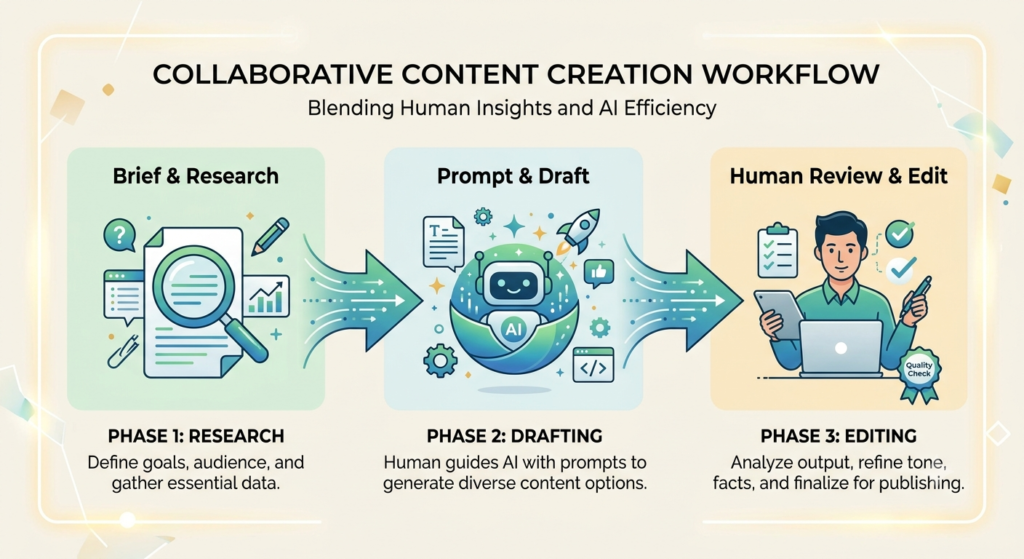
Once I understand the purpose and audience, I give AI a detailed brief. Not a one-line instruction like “write a blog about AI in marketing.”
Instead, something like: “Write an article for marketing directors who are learning to integrate AI into their workflows. The goal is to help them understand realistic ROI and avoid common mistakes. Use a conversational tone. Include a real client example showing measurable results. Primary keyword: ‘role of AI in digital marketing.’ Secondary keywords: ‘AI for content marketing.’ Target audience: 5+ years marketing experience. Key points to cover: [list]. Avoid: [list].”
The quality of AI’s output is directly proportional to the quality of your input. Better brief equals better draft.
The Human Review and Optimization Phase
This is where AI drafts become real content.
I read through every section. Anything generic gets removed. Anything that sounds like AI writing—rather than human thinking—gets rewritten. I add examples from real experience. I make sure the tone matches the brand voice. I verify any claims or statistics.
Then I optimize for both readers and search engines. Are the headings clear? Does the primary keyword appear naturally in the introduction, headings, and conclusion? Is the content actually answering the questions someone is searching for? Does it flow logically?
Finally, I check readability. Long paragraphs become short ones. Walls of text break into bullet points. Ideas that could be clearer get rephrased.
Before publishing, I ask myself one question: If I searched for this topic, would I actually find this useful? If the answer is anything less than “yes,” I keep refining.
Common Mistakes That Kill AI-Generated Content
The content that fails—the posts that rank nowhere, that generate no engagement, that don’t drive business results—usually fails for the same reasons.
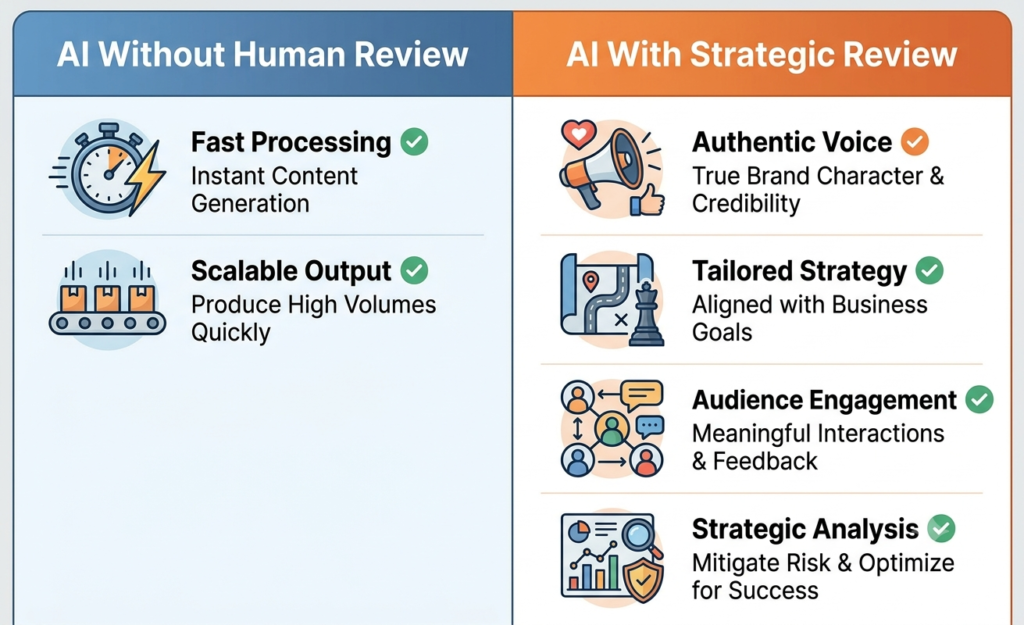
Mistake #1: No Human Review. Publishing AI output without reading it. Removing quotes that might be inaccurate. Not checking whether it sounds like your brand. Not verifying claims.
Mistake #2: Insufficient Context. Giving AI a vague instruction and expecting a specific result. The broader your request, the broader (and more generic) the response.
Mistake #3: Skipping SEO Validation. AI can suggest keyword placements and content structure, but it doesn’t always understand current search trends or Google’s quality standards. You still need to verify that the content aligns with what’s actually ranking and what audiences are actually searching for.
Mistake #4: Treating AI as Replacement, Not Tool. The best content comes from collaboration—AI speeds up research and drafting, but human judgment decides strategy, voice, and authenticity.
Mistake #5: Inconsistent Quality Control. Rushing some pieces, carefully refining others. Inconsistency damages credibility. If readers trust one article on your site, they expect that same quality everywhere.
Real Results: What AI-Driven Content Actually Delivers
Numbers matter. Especially when deciding whether to invest time in a new approach.
The local business campaign I mentioned earlier isn’t unique. When AI is used strategically—not as autopilot, but as a collaborative productivity tool—you see measurable results.
Traffic gains are the most obvious. The 35% organic traffic increase wasn’t because AI wrote magical content. It came from being able to produce more content, faster, targeting more customer questions, and testing more variations than the traditional process allowed. More content targeting real search queries equals more visibility.
Ranking improvements follow from that. Multiple target keywords reaching page one. Not from AI magic, but from having time to optimize more thoroughly and publish more comprehensively on the topic.
Business impact comes next. More qualified website inquiries. Longer average session duration on blog pages (a signal that content is actually useful). Higher engagement rates on social posts.
Production efficiency shouldn’t be underestimated either. A well-researched blog used to take a full working day. Using AI for research, outlining, and initial drafting cuts that to a few hours. That time doesn’t disappear—it goes toward deeper strategic work. Analyzing what’s actually converting. Refining messaging. Planning the next content series based on performance data.
That’s the real ROI: not “AI writes blogs now,” but “we can produce more strategic, better-optimized content while spending more time on strategy itself.”
The Skills That Matter More Now
Here’s what might sound counterintuitive: as AI became more capable at producing marketing content, the demand for skilled marketers actually increased, not decreased.
The technical work is getting easier. First drafts are faster. Research is quicker. The things that are becoming scarce—and therefore valuable—are the human skills that no AI can replicate.
Strategic thinking. AI can generate options. It can’t decide which direction aligns with business goals, competitive advantage, and audience needs. That requires judgment.
Customer psychology. AI recognizes patterns in data. But knowing what motivates people, what problems keep them up at night, what emotions drive their decisions—that comes from working with real customers, listening, observing. That’s lived experience.
Storytelling. Generic content is getting cheaper to produce. The internet is filling with similar-sounding articles because AI can generate them at scale. The brands that stand out tell authentic stories, share real experiences, use unique voice. That’s not an AI skill. That’s a human skill.
Critical thinking and editing. AI produces a lot of output. Knowing what’s good, what’s weak, what needs to change—that’s judgment. Fact-checking claims. Removing inaccuracies. Improving content until it genuinely delivers value. That’s skilled work.
Relationship building. Clients, team members, audiences. Trust is built through genuine communication. Technology can make the process faster, but relationships still depend on human connection.
The marketers winning right now aren’t the ones using AI. They’re the ones using AI well—which means they’re combining AI’s speed with human insight, creativity, and judgment.
AI as a Productivity Multiplier, Not a Replacement
The future Role of AI in digital marketing isn’t about automation. It’s not about replacing marketing teams. It’s about amplifying what good marketers can accomplish.
Think of it like this: AI is the junior team member who’s excellent at research and first drafts but needs careful direction and thorough review. Give it clear instructions, review everything it produces, and you have a teammate that’s genuinely useful. Expect it to work independently without oversight, and you’ll get generic, unusable output.
The role of AI in digital marketing, moving forward, is exactly this: speed up the repetitive work so strategists can spend more time on strategy. Handle the bulk of research so marketers can focus on insight. Generate variations so teams can test more ideas. Process data so humans can focus on judgment calls.
That’s not the future where AI replaces marketers. It’s the future where marketing gets better because teams have more time to do the thinking work that actually matters.The Skills That Matter Now
Here’s what might sound strange: as AI became better at creating marketing content the need for skilled marketers actually went up not down.
The technical tasks are becoming easier. First drafts are faster. Research is quicker. The things that are becoming rare—and therefore important—are the skills that no AI can copy.
Strategic thinking. AI can come up with ideas. It can’t choose which path fits with company goals, strengths and what customers want. That takes decision-making.
Customer psychology. AI sees patterns in numbers. But understanding what makes people act what worries them what feelings influence their choices—that comes from working with people listening, watching. That’s experience.
Storytelling. Generic content is getting cheaper to make. The web is full of sounding articles because AI can create them quickly. The brands that stand out share stories talk about real experiences use a special way of speaking. That’s not an AI skill. That’s a skill.
Critical. Editing. AI creates a lot of work. Knowing what’s good whats wrong what needs to be changed—that’s judgment. Checking facts. Removing errors. Improving content until it truly helps. That’s work.
Relationship building. Clients, coworkers, audiences. Trust is created through communication. Tech can make the process faster. Relationships still need human connection.
The marketers who are succeeding now aren’t the ones using AI. They’re the ones using AI well—which means they’re mixing AIs speed, with insight, creativity and judgment.
Frequently Asked Questions
1Q: Will AI eventually replace marketing jobs?
A: The technical work is getting automated, yes. But the strategic work—understanding audiences, building strategy, making judgment calls—is becoming more valuable, not less. The marketers who adapt and learn to work with AI effectively will thrive. Those who rely solely on technical execution are vulnerable.
2Q: How much time can AI actually save?
A: Depending on the task, between 30–60% of production time. Research, drafting, and initial optimization are faster. The review, refinement, and strategic decisions still take human time. But that time investment is smaller than before, so you can do more with the same resources.
3Q: Can I just publish AI-generated content without editing?
A: You can. Most people do. Most of that content ranks nowhere and generates no business value. The content that wins is carefully reviewed, brand-voice-aligned, and fact-checked.
4Q: What’s the best way to get started using AI in my marketing?
A: Start with one project. Use it to accelerate research and first drafts. Be rigorous about reviewing and refining. Measure results. Then apply what you learned to your next project. The learning happens in doing, not in reading about it.
5Q: How do I know if my AI-generated content is good enough to publish?
A: Ask yourself: Would I actually find this useful if I searched for this topic? Is it better than what’s already ranking? Does it match my brand voice? Does it answer real questions my audience is searching for? If you can’t answer “yes” to all of those, keep refining.
Conclusion: The Marketer’s Advantage Hasn’t Changed
The role of AI in Digital marketing is Inevitable. It’s accelerating research, enabling faster iteration, making it possible to produce more content in less time.
But the fundamentals of good marketing haven’t changed.
You still need to understand your audience. You still need a strategy. You still need to create something genuinely useful, not just something polished. You still need judgment, creativity, and authenticity.
What’s changed is the speed at which good marketers can execute. AI has removed the friction from production so that strategy, insight, and authenticity become even more important.
The role of AI in digital marketing isn’t about replacing human decision-making. It’s about amplifying it. The marketers who understand this—who use AI as a collaborative tool rather than a shortcut—are the ones building campaigns that actually work.
Start with one project. Give AI clear direction. Review everything carefully. Measure results. Learn from what works. Then scale that process.
That’s how you get the most from AI while maintaining the human judgment that makes marketing genuinely effective.